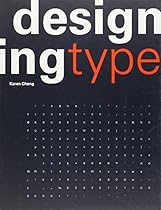
Designing Type
| Author | : | |
| Rating | : | 4.17 (922 Votes) |
| Asin | : | 0300111509 |
| Format Type | : | paperback |
| Number of Pages | : | 224 Pages |
| Publish Date | : | 2014-03-25 |
| Language | : | English |

DESCRIPTION:
Did you learn this in design school? Ok, you slugged it through design school where you learned about typefaces like serif, sans serif, ornamentalthe works. While you now know the difference between Bauhaus and Arial, you still don't know how to design a typeface. Designing Type can rescue you, especially if you need to design a typeface in a hurry for a client who demands something to go with his product lineAuthor Karen Cheng, associate professor at the University of Washington's Visual Communication Design Program in . A Classic Text on Type Design Absolutely a must have for aspiring and junior typeface or logo designers. However, the book is not an easy read; it should be read cover to cover with patience before being used as a workbook reference. Its text requires a sound prior knowledge of typography and related technologies. And it must be read in tandem with close observation of the numerous illustrations and diagrams to be fully understood and appreciated. The information shared by the author is not available elsewhere unl. "Visual construction of letters" according to Jasen Kavel. This book is indispensible for anyone who designs type. Clear illustrations show the visual construction of letters. For instance, on pages 100-101, an outline of the letter "v" placed directly over a shaded "y" in nine serif typeface examples make it clear that the "y" is not just a "v" with a descending tail. Is the sans serif "u" just an upside-down "n"? Pages 1Visual construction of letters Jasen Kavel This book is indispensible for anyone who designs type. Clear illustrations show the visual construction of letters. For instance, on pages 100-101, an outline of the letter "v" placed directly over a shaded "y" in nine serif typeface examples make it clear that the "y" is not just a "v" with a descending tail. Is the sans serif "u" just an upside-down "n"? Pages 146-147 show with several examples that it's not quite that simple. Many visual details on every letter (including numbers . 6-1Visual construction of letters Jasen Kavel This book is indispensible for anyone who designs type. Clear illustrations show the visual construction of letters. For instance, on pages 100-101, an outline of the letter "v" placed directly over a shaded "y" in nine serif typeface examples make it clear that the "y" is not just a "v" with a descending tail. Is the sans serif "u" just an upside-down "n"? Pages 146-147 show with several examples that it's not quite that simple. Many visual details on every letter (including numbers . 7 show with several examples that it's not quite that simple. Many visual details on every letter (including numbers
About the AuthorKaren Cheng is a graphic designer and associate professor in the visual communications program at the University of Washington, Seattle.
This essential book explains the processes behind creating and designing type. One of the most essential tools of graphic design, typography influences the appearance of visual print materials perhaps more than any other component. As design clients increasingly call for original and custom typefaces, Designing Type is a superb reference for both students and professional graphic designers. . The book provides detailed guidelines for creating serif and sans serif letters, numbers, punctuation, and accents. Introductory essays and diagrams emphasize the history of type, the primary systems of typeface classification, the two main proportional systems for type, the parts of a letter, the effects of new technology on design methodology, the optical illusions that affect density and balance in letterforms, and the differences in form between basic serif typestyles. A wide ra
Karen Cheng is a graphic designer and associate professor in the visual communications program at the University of Washington, Seattle.